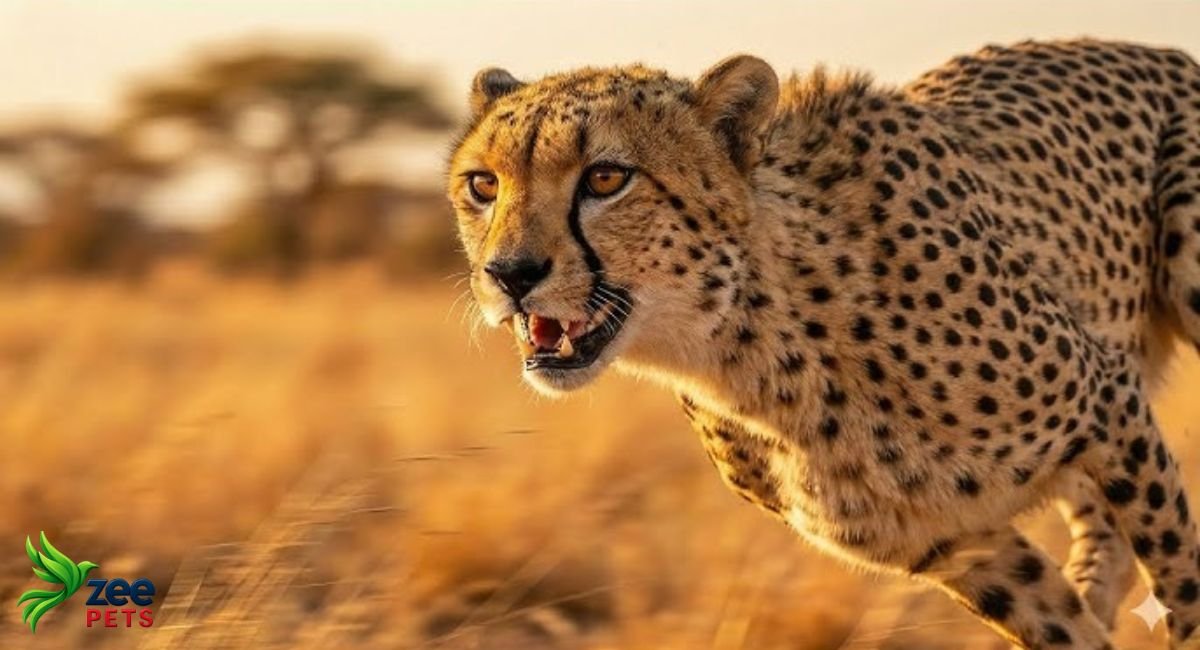
There is a moment on the open plains of Africa when the grass suddenly goes still, a pair of amber eyes lock onto a distant gazelle, and within a few heartbeats the fastest land animal on Earth turns into a blur of motion. Watching a cheetah accelerate is one of the most thrilling sights in nature. In under three seconds, this animal can go from a standstill to speeds that would get it a speeding ticket on most highways. But what actually happens inside a cheetah’s body during those few explosive seconds? The answer is a story of evolution pushing one animal to the absolute edge of what a land mammal can physically do.
A Body Designed Like a Living Arrow
Everything about a cheetah’s frame exists for one purpose: reducing anything that might slow it down. Its skull is small and light, its collarbones are reduced, and its rib cage is deep and narrow rather than wide and heavy. Even its skin is thinner than that of other big cats, shaving off extra weight that would otherwise work against speed.
This is not an animal built for wrestling prey to the ground like a lion. A cheetah’s muscles are lean and built almost entirely for short bursts of explosive effort rather than sustained strength. Every part of its skeleton, right down to the shape of its shoulder blades, seems to have been sculpted by nature with a single goal in mind: get from zero to full speed as fast as possible, and hold that speed just long enough to catch a meal.
The Spine That Works Like a Spring
Perhaps the single most important secret behind a cheetah’s speed is not in its legs at all. It is in its spine.
Unlike most animals, whose backbones stay relatively stiff while running, a cheetah’s spine flexes dramatically with every stride. As the animal gathers its back legs underneath its body, the spine curves inward like a coiled spring storing energy. A split second later, that stored energy releases as the spine snaps into an extended position, flinging the front legs forward and adding tremendous extra reach to each stride.
This spinal flex effectively acts as a fifth limb, multiplying the power generated by the legs themselves. It allows a cheetah’s stride length to stretch out further than almost any other land animal relative to its body size, letting it cover enormous ground with each bound.
Legs Built for One Job Only
A cheetah’s legs are long, thin, and packed with fast twitch muscle fibers, the type of muscle tissue built for quick, powerful bursts rather than long lasting endurance. These fibers contract rapidly, generating tremendous force in an instant, which is exactly what is needed to launch the body forward at top speed.
At full sprint, a cheetah can take more than three strides every second, and during certain phases of that stride, all four paws leave the ground at once, not just when the legs are extended, but also when they are tightly gathered beneath the body. This double airborne phase is rare among animals and is part of what allows the cheetah’s stride to become so incredibly long and efficient.
Claws That Grip Like Cleats
Most cats retract their claws to keep them sharp for hunting or climbing. Cheetahs are different. Their claws stay only partly retractable and function much like the cleats on a sprinter’s shoes, digging into the ground for extra traction during acceleration and sharp turns.
This constant grip matters enormously at high speed. Without it, a cheetah’s paws would slip on loose dirt or dry grass the moment it tried to push off with real force. The slightly blunted, dog like claws give the cheetah a level of control that lets it launch, turn, and stop with a level of precision that would otherwise be impossible at such extreme velocity.
A Tail That Steers Like a Rudder
Speed alone would be useless if a cheetah could not stay in control during a chase. Prey animals rarely run in a straight line. They juke, cut, and change direction unpredictably, and a cheetah has to match every one of those movements without losing its balance.
This is where the cheetah’s long, thick tail comes into play. Acting almost like a rudder on a boat, the tail shifts side to side to counterbalance sudden turns, keeping the body stable even during sharp cuts at full speed. Without this built in counterweight, the same turns that a cheetah performs smoothly would send it tumbling across the ground.
Lungs and Heart Working in Overdrive
Sprinting at such extreme speed puts a massive strain on the body, and a cheetah’s internal organs have adapted accordingly. Its lungs and heart are proportionally larger than those of most other cats, allowing it to take in and circulate far more oxygen in a short amount of time.
Even its nostrils are unusually large, letting the animal pull in huge volumes of air with each breath during a chase. All of this extra oxygen intake fuels the muscles during their brief but intense burst of effort, though it comes at a cost. A cheetah’s body heats up dramatically during a full sprint, and this is one of the main reasons chases rarely last more than twenty or thirty seconds. If a cheetah pushes much longer than that, the risk of overheating becomes dangerous, forcing it to break off the chase even if the prey is still within reach.
Why Short Bursts Matter More Than Endurance
It might seem strange that the fastest land animal on the planet cannot maintain that speed for long, but this trade off is central to how cheetahs survive. Every part of their body sacrifices long distance stamina in exchange for explosive acceleration and blistering top speed.
This means a cheetah’s hunting strategy depends heavily on getting close to its prey before the chase even begins. Rather than running down prey from a distance the way wolves might, cheetahs rely on stealth, patience, and careful stalking to close the gap first, saving their burst of speed for the final, decisive seconds. A failed stalk often means a failed hunt entirely, since the cheetah simply cannot afford to burn through its limited energy reserves chasing something too far away.
The Danger That Comes With Being Built for Speed
All of this specialization comes with real risks. A cheetah’s lightweight frame and thin build, while perfect for sprinting, leave it poorly equipped to fight off larger predators like lions or hyenas. Even a successful hunt can turn disastrous if a stronger predator arrives and steals the kill, something that happens often enough that cheetahs frequently eat quickly and cautiously, watching their surroundings the entire time.
Cheetah cubs face even steeper challenges, with survival rates in the wild remaining low due to predation from other large carnivores that see them as easy targets. As a result, mother cheetahs must constantly balance the need to hunt and feed themselves against the danger of leaving their cubs unprotected.
A Species Under Pressure
Beyond the natural risks they already face, cheetahs today are dealing with mounting pressure from habitat loss and human expansion. Open grasslands, which cheetahs depend on for both hunting and their high speed chases, are steadily shrinking as land is converted for farming and development.
Genetic diversity is another serious concern. Cheetah populations went through a dramatic bottleneck in their evolutionary past, leaving the species with unusually low genetic variation compared to most other mammals. This makes them more vulnerable to disease and reduces their ability to adapt to environmental changes.
Conservation groups across Africa and parts of Iran, where a small population still survives, are working to protect large stretches of open habitat, reduce conflict with farming communities, and maintain safe corridors that allow cheetahs to roam and hunt without crossing into dangerous human territory.
The Fastest Sprint in Nature Deserves Our Respect
A cheetah reaching full speed is not simply a fast animal running. It is the result of millions of years of evolutionary fine tuning, where every bone, muscle, and organ works together toward a single explosive goal. The flexing spine, the spring loaded legs, the gripping claws, the balancing tail, and the oversized heart and lungs all combine into one of the most extraordinary displays of raw athletic power found anywhere in the animal kingdom.
It lasts only seconds, but those seconds represent one of nature’s most refined engineering achievements. The next time you see footage of a cheetah exploding into a sprint across the savanna, it is worth remembering that you are not just watching a fast animal. You are watching millions of years of evolution compressed into a single, breathtaking burst of speed.